I’m Not Doing Enough
Minimum effective dose is the strategy that works
By
July 7, 2026
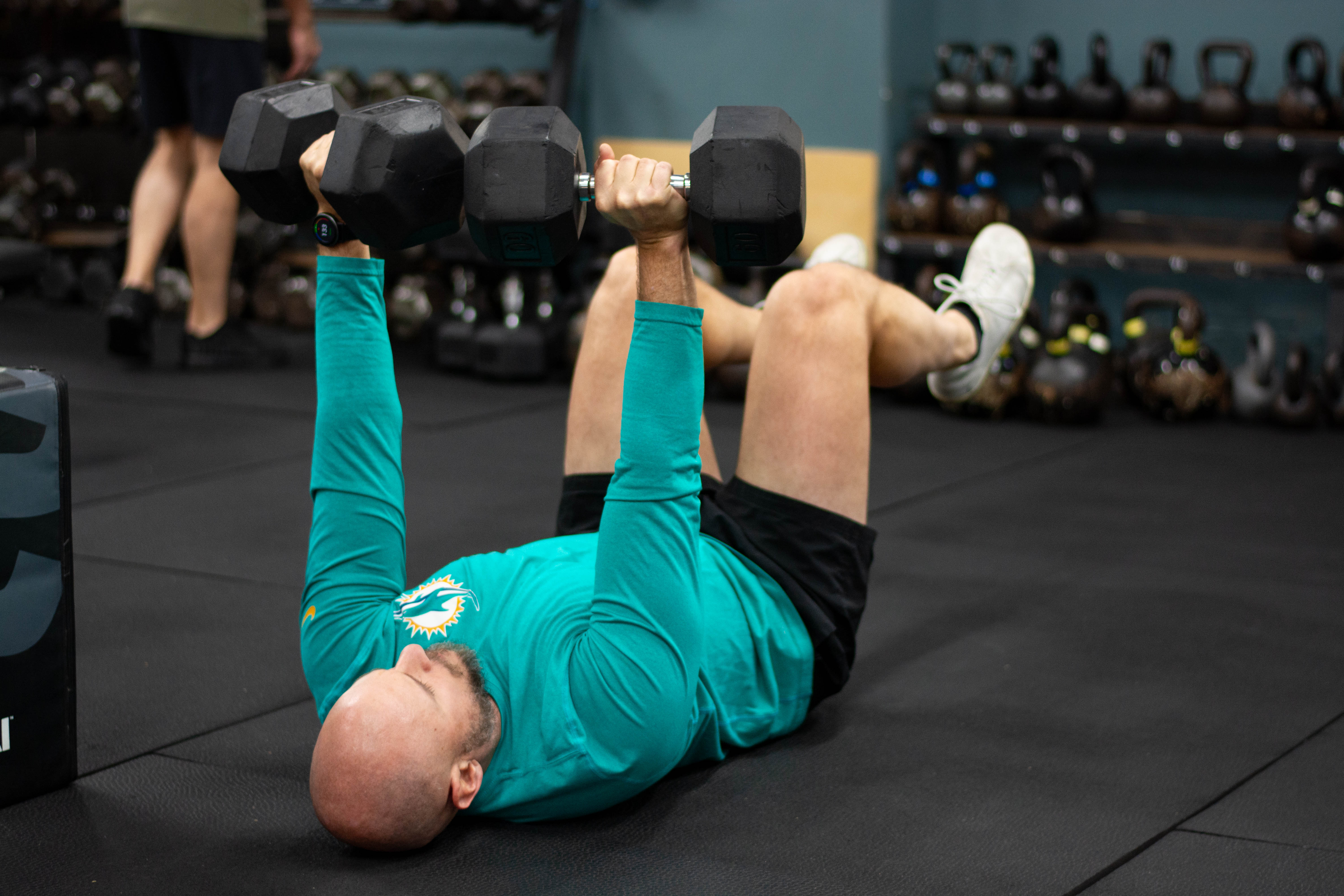

“I feel like I’m not doing enough.” We often hear this from people who join Vero Strength with CrossFit or HIIT backgrounds. Because they are used to workouts that regularly leave them gasping on the floor, doing dozens of reps or working to failure, our program doesn't feel like enough training. But feelings are not facts. So, I’m here to present evidence to support the fact that you shouldn’t be emptying the tank every day.
There’s a concept called the minimum effective dose (MED). The idea here is simple: there's a threshold of training stimulus needed to produce a result, and once you cross it, doing more doesn't automatically mean getting more. Below the threshold, you leave gains on the table. Above it, you're often just adding fatigue without adding benefit.
This is an actual area of research in sports science. A 2021 multi-experiment study on powerlifters found that a very low training volume, in some cases as few as two to three heavy singles per lift per week, was enough to produce meaningful 1RM strength gains in already-strong athletes. Separate research on resistance-trained lifters has shown a general consensus of around 4 sets per muscle group per week to maintain strength, with roughly 6 to 10 hard sets per week driving both strength and hypertrophy.
The point isn't that everyone should train with just two sets a week. It's that "more" has diminishing, and eventually negative, returns. Training a muscle group twice a week tends to outperform once a week for both size and strength, but past a certain volume, you're not stacking gains; you're stacking fatigue.
We train all week and “test” on Saturdays in the form of a metcon (short for metabolic conditioning). This is a high-intensity test. Often, when people don’t perform well on the test, they think they just need to test more, but in reality, they need to spend more time on the elements of training - the better you move, the stronger you are the better you can pace, the more successful the test will be. Imagine if football players or fighters were tested daily with a game or a match, that would spell disaster.
One big issue with chronic overtraining is that it can wreak havoc on your hormones. A systematic review of overtraining syndrome research found consistent patterns across studies: decreased resting testosterone, elevated or dysregulated resting cortisol, and a lowered testosterone-to-cortisol ratio, a marker researchers use specifically to track whether someone's system is in a net anabolic (building) or catabolic (breaking down) state. Other research has found that in advanced stages of overtraining, cortisol's normal response to a stress test is blunted entirely, along with growth hormone and ACTH (a natural hormone released by the pituitary gland) responses, meaning the system is stuck. We’ve actually seen many people improve their health and performance and even lose weight by reducing the volume of their training.
Testosterone and cortisol both follow natural daily rhythms, and both play a direct role in how your body handles protein and carbohydrate metabolism during recovery. When training stress consistently outpaces recovery capacity, that balance tips toward the catabolic side (it burns muscle).
Overtraining shows up as flat performance, poor sleep, nagging fatigue that doesn't respond to more effort, and eventually a plateau that no amount of extra work will fix, because the extra work is the problem.
At Vero Strength, our programming aims to find the stimulus that produces real, lasting adaptation. That’s why you will see planned rest between sets, recovery days that are part of the plan (we are closed on Sundays for that reason), and lower-effort days, like many Thursdays.
The fatigue-chasing model might feel productive, but the research is consistent: strength is built during recovery and undermined by a hormonal environment that never gets a chance to reset. Minimum effective dose isn't the easy way out. It's the strategy that actually works.